










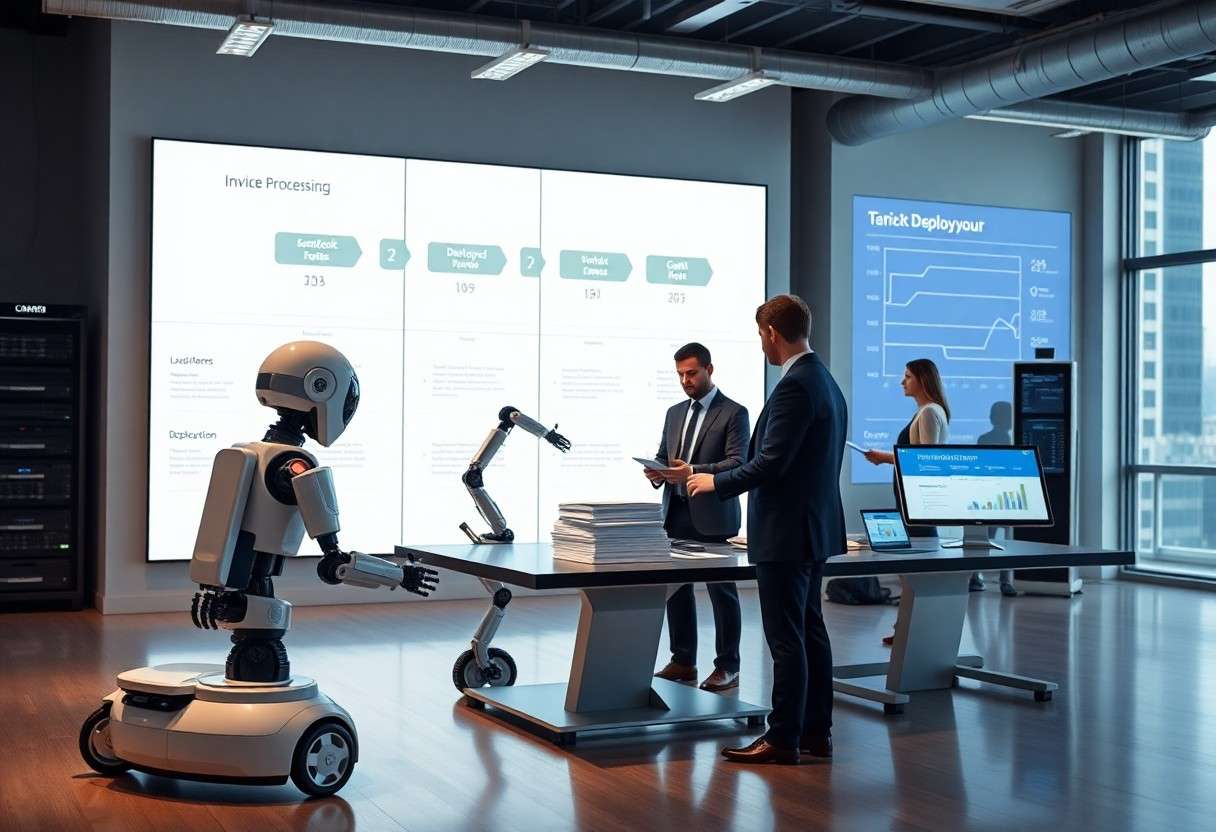
Most businesses now rely on autonomous agents to automate complex tasks without human intervention. You see real-time decision-making reshape operations, reduce errors, and cut costs. While unmonitored AI behavior poses risks, proper oversight turns agentic AI into a powerful, efficient force in modern workflows.
Key Takeaways:
- Autonomous agents can perform complex tasks independently, reducing manual effort in areas like customer service, data processing, and supply chain management.
- Businesses using agentic AI report faster decision cycles and improved accuracy, especially when agents continuously learn from real-time feedback.
- Integration of autonomous agents into existing workflows requires clear guardrails to ensure reliability, ethical compliance, and alignment with business goals.
The Dawn of the Synthetic Colleague
You’re no longer just automating tasks-you’re welcoming a new kind of team member. This synthetic colleague thinks, adapts, and acts independently, reshaping how work gets done across departments.
Organizations that once relied on rigid software now see dynamic AI agents making real-time decisions. These agents don’t wait for commands-they anticipate needs, reducing delays and boosting responsiveness in customer service, logistics, and operations.
Transitioning from Tools to Active Entities
Software used to follow orders. Now, you interact with systems that initiate actions based on context and goals. Agents interpret objectives, break them into steps, and execute autonomously, mimicking human problem-solving.
Tasks like data validation or invoice processing no longer stall waiting for input. Your AI colleague identifies discrepancies, resolves them, and escalates only when necessary. This shift reduces bottlenecks and increases throughput without expanding headcount.
The Mechanics of Independent Reasoning
Reasoning isn’t programmed-it’s emergent. Your agent evaluates options, weighs outcomes, and chooses paths using internal models trained on vast datasets. It revises decisions when new information arrives, much like a seasoned employee.
Each action stems from layered logic: perception, planning, reflection. You observe agents correcting course mid-task, learning from failure, and optimizing workflows in real time. This autonomy is the core of agentic intelligence.
Independent reasoning means your AI doesn’t just apply rules-it creates strategies. It might reroute a supply chain during disruption or adjust pricing based on market signals, all without intervention. The danger lies in unchecked autonomy, where misaligned goals lead to unintended consequences. That’s why oversight loops and goal constraints are non-negotiable in deployment.
Structural Shifts in Corporate Logic
You’re no longer optimizing human-led processes-you’re rebuilding them for algorithmic decision-making at machine speed. This shift replaces hierarchical approvals with autonomous agents that act in real time, driven by data, not delays. As workflows evolve beyond manual oversight, Agentic Workflows: How Autonomous AI Executes … becomes the blueprint for operational agility.
Redesigning Workflow for Algorithmic Speed
Speed demands structure. Your workflows must shed sequential bottlenecks and embrace parallel, event-driven execution. Autonomous agents process inputs instantly, triggering actions without waiting for human validation. This isn’t automation-it’s continuous operation.
Decisions now emerge from live data streams, not weekly reports. When an agent detects a supply chain delay, it reroutes logistics and adjusts inventory forecasts in seconds. Your business doesn’t react-it anticipates.
Integrating Autonomy into Legacy Frameworks
Legacy systems don’t vanish overnight. You must embed agents where they can operate safely within existing IT architecture. Isolated agent pods can run alongside ERP or CRM tools, exchanging data without overhauling decades-old infrastructure.
Start with low-risk, high-frequency tasks like invoice validation or customer tagging. These small wins prove reliability while minimizing disruption. Over time, agents learn legacy logic and begin suggesting process improvements.
Integrating autonomy into legacy frameworks requires more than technical compatibility-it demands cultural alignment. Teams must trust agent decisions even when the logic isn’t immediately transparent. Monitoring dashboards with clear audit trails help build that confidence, ensuring compliance and accountability remain intact even as control shifts from people to systems.
The Multi-Agent Ecosystem
You’re already seeing how individual agents streamline tasks, but the real shift happens when multiple agents work together. In a multi-agent ecosystem, specialized AI entities communicate and coordinate to achieve complex business outcomes. These systems mimic team dynamics, where each agent has a role, improving response times and decision accuracy across departments. Learn more about how agentic AI workflows improve efficiency and agility in real-world applications.
Protocols for Machine Cooperation
Agents rely on standardized communication protocols to exchange data and delegate tasks without human oversight. These rules ensure consistency, reduce conflicts, and enable real-time synchronization across distributed systems. You benefit from fewer errors and faster execution when agents understand each other’s intent and constraints.
Managing Distributed Digital Intelligence
Orchestrating intelligence across multiple agents demands centralized oversight with decentralized execution. You maintain control through monitoring dashboards that track performance, detect anomalies, and enable dynamic reassignment of tasks. This balance ensures scalability and resilience, even as workloads fluctuate.
With distributed digital intelligence, your organization gains the ability to run parallel workflows across geographies and functions. Each agent operates autonomously yet contributes to a unified goal, creating a responsive, adaptive system. The result is continuous operation without single points of failure, giving you unmatched operational durability.
Economic Gains of the Infinite Worker
You unlock new levels of efficiency when autonomous agents operate continuously without downtime. Unlike human workers, these digital entities persist across time zones and tasks, driving down operational latency. Understanding Agentic AI: Shaping Autonomous Workflows reveals how businesses scale output without proportional cost increases. The infinite worker doesn’t sleep, yet adheres precisely to compliance and logic frameworks.
Reducing Friction in Complex Processes
Complex workflows often stall due to handoffs between teams or systems. Agentic AI eliminates bottlenecks by acting as a persistent coordinator, interpreting context and moving tasks forward autonomously. You experience faster resolution times and fewer errors when decisions are executed in real time without waiting for approvals or updates.
Maximizing Throughput without Human Fatigue
Your systems achieve peak performance when AI agents handle high-volume tasks around the clock. Throughput scales linearly with demand,不受疲劳影响, ensuring consistent output during surges. This endurance allows your business to meet service-level agreements reliably, even under unpredictable loads.
Imagine processing thousands of invoices, support tickets, or data entries every hour-without degradation in accuracy. Human teams require rest, but agentic workflows do not. You gain a sustainable edge by maintaining velocity where others slow down, turning capacity into a strategic asset.
Security in an Unsupervised World
Autonomous agents operate without constant human oversight, creating new attack surfaces. You must assume breaches will happen and design systems that limit damage when they do. Unchecked autonomy can lead to cascading failures if not governed by strict access controls and real-time monitoring.
Every agent becomes a potential entry point. You need zero-trust architectures where permissions are granted per task, not per identity. Agents that can modify their own logic pose the greatest risk-containment boundaries are non-negotiable.
Safety Constraints for Autonomous Logic
Agents make decisions in milliseconds, but those decisions must align with predefined safety rules. You can’t rely on post-action audits when outcomes are irreversible. Hardcoded constraints prevent agents from executing harmful sequences, even if data suggests it’s optimal.
Your systems should include circuit breakers that halt operations when anomalies exceed thresholds. These aren’t optional safeguards-they’re embedded limits that preserve operational integrity under uncertainty.
Ensuring Fidelity in Machine Decisions
Decisions made by autonomous agents must reflect your business rules, not statistical approximations. You lose trust the moment an agent acts contrary to policy, even if the outcome seems favorable. Fidelity means consistency with intent, not just accuracy in output.
An agent recommending a high-risk sale might boost short-term revenue, but if it violates compliance protocols, the long-term cost outweighs any gain. You need decision provenance-clear, auditable trails showing how and why each choice was made.
When fidelity is maintained, every action an agent takes can be traced back to an authorized rule set or policy framework. This isn’t just about avoiding errors-it’s about ensuring that machine behavior remains predictable and aligned with organizational values, even as environments change. You build accountability into the system by design, not as an afterthought.
The Next Epoch of Productivity
You’re entering a phase where autonomous agents don’t just assist but anticipate. These systems process inputs, make decisions, and execute tasks with minimal intervention, dramatically compressing cycle times. Work that once required days now completes in minutes, freeing teams to focus on higher-order challenges.
Intelligent workflows adapt in real time, learning from outcomes and refining approaches. This isn’t automation-it’s agentic behavior, where AI acts with purpose. You’re no longer managing tasks; you’re orchestrating intelligent systems that scale cognition across operations.
Reimagining the Role of Human Oversight
Human judgment shifts from routine validation to strategic guidance. You’re no longer checking every step but defining boundaries, ethics, and intent for agents to follow. This oversight ensures alignment while allowing AI the autonomy to operate within safe parameters.
Your role becomes one of curation and correction. When anomalies arise, you step in-not to redo work, but to refine logic. This balance preserves accountability while unlocking speed, turning supervision into a force multiplier rather than a bottleneck.
Scaling Thought Across the Enterprise
Agents replicate expert reasoning across departments, applying proven decision frameworks to new contexts. You’re not just deploying software-you’re distributing intelligence. This allows regional teams, support desks, and supply chains to operate with the same cognitive rigor as central experts.
Knowledge gaps shrink as AI internalizes tribal wisdom and applies it consistently. Enterprise-wide coherence emerges not from mandates, but from shared, scalable thought patterns embedded in agent behavior.
Scaling thought means embedding decision logic from top performers into autonomous systems that operate 24/7. You’re no longer limited by headcount or training cycles-agents propagate insight instantly, turning isolated expertise into organizational capability. This is how companies achieve uniform quality at unprecedented speed.
To wrap up
As a reminder, autonomous agents are reshaping how your business processes operate by acting independently to complete complex tasks. You already see them streamlining customer service, optimizing supply chains, and reducing manual oversight. These agents don’t just follow scripts-they assess situations, make decisions, and adapt in real time. Your workflows become faster and more accurate without constant supervision. The shift isn’t futuristic-it’s happening now, and businesses using agentic AI gain measurable efficiency and responsiveness.
FAQ
Q: How do autonomous agents differ from traditional automation tools in business workflows?
A: Autonomous agents go beyond rule-based automation by making decisions independently using real-time data and learning from outcomes. Traditional automation follows fixed scripts and requires manual updates for new scenarios. An autonomous agent can assess a customer support ticket, determine urgency, gather relevant information from multiple systems, and assign or resolve the issue without human input. These agents adapt to changing conditions, such as shifting supply chain delays or fluctuating demand, allowing businesses to respond faster and with fewer errors.
Q: Can autonomous agents work across different departments like sales, operations, and finance?
A: Yes, autonomous agents are designed to operate across departmental boundaries by integrating with existing software and understanding cross-functional data. In sales, an agent might identify high-potential leads by analyzing website behavior and past purchases. In operations, it could adjust inventory orders based on delivery timelines and warehouse capacity. In finance, the same agent might flag unusual spending patterns or forecast cash flow changes. Each agent maintains consistent communication between systems, reducing silos and ensuring decisions reflect a complete view of the business.
Q: What safeguards are in place to ensure autonomous agents make reliable and ethical decisions?
A: Reliable operation depends on clear goals, transparent logic, and continuous monitoring. Agents run within defined boundaries-such as spending limits or approval thresholds-and log every action for audit. Businesses set guardrails using policy rules and human-in-the-loop checkpoints for high-impact decisions. Regular performance reviews track accuracy and fairness, especially in sensitive areas like hiring or lending. If an agent encounters an unfamiliar situation, it escalates to a human instead of acting unpredictably. This balance allows automation to scale safely without sacrificing accountability.