









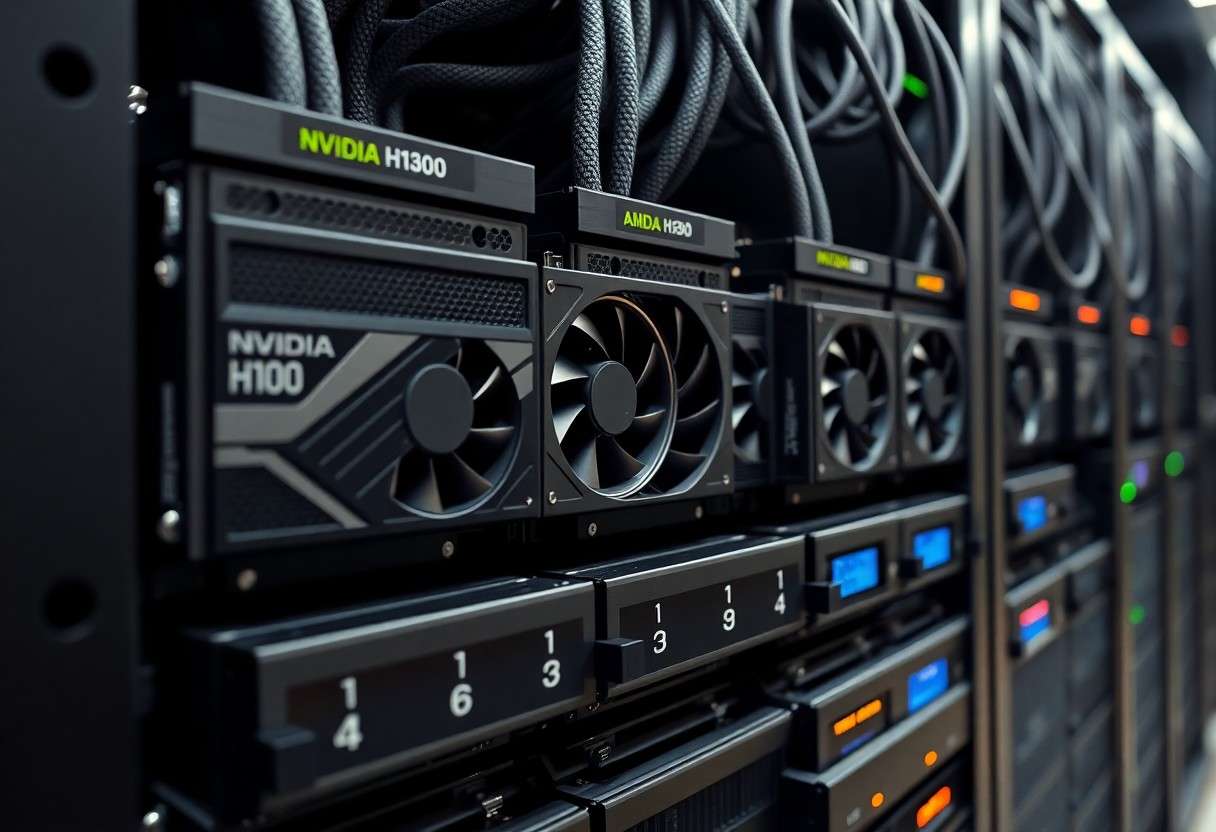
It’s time to unlock the full potential of the H100, MI300, and Gaudi 3 for your AI workloads. You can achieve up to 4x faster training times by optimizing hardware integration and software stack alignment. Ignoring memory bandwidth limits or cooling demands risks severe performance throttling. These chips deliver unmatched throughput-if configured with precision.
Key Takeaways:
- NVIDIA H100 delivers exceptional performance for large-scale AI training and inference tasks, thanks to its advanced Hopper architecture and high memory bandwidth, making it a top choice for data centers handling demanding workloads.
- AMD MI300 stands out with its chiplet design and integrated CPU-GPU configuration, offering strong competition in AI and high-performance computing by balancing power efficiency and compute density.
- Intel Gaudi 3 provides a cost-effective alternative with purpose-built architecture for deep learning, supporting popular frameworks and delivering competitive throughput for training and inference without relying on GPU-centric designs.
Step 1: Choosing Your Silicon
Selecting the right accelerator defines your AI system’s performance ceiling. You must evaluate raw compute, memory bandwidth, and software maturity before committing. Each platform brings distinct strengths, and your workload type should guide the decision.
Hardware choice impacts scalability, power efficiency, and long-term maintenance. You’re not just buying silicon-you’re investing in an ecosystem. Compatibility with frameworks like PyTorch or TensorFlow can make or break deployment speed.
The H100 Advantage
H100 delivers unmatched FP8 performance for large-scale training and inference. Its NVLink integration enables multi-GPU scaling with minimal latency, ideal for data centers pushing AI boundaries.
You gain access to transformer engine acceleration, drastically reducing training time for language models. With 80GB of HBM3 memory, the H100 handles massive batches without bottlenecks, giving you a clear edge in throughput.
The MI300 Alternative
MI300 offers a compelling AMD-based path with 256GB of unified memory, merging CPU and GPU memory spaces. This architecture simplifies memory management for large parameter models.
You benefit from strong ROCm support and competitive pricing, making MI300 a cost-efficient option for high-performance AI. Its chiplet design enables scalability while maintaining power efficiency.
What sets MI300 apart is its integrated CPU-GPU die configuration, allowing faster data sharing across compute units. You avoid traditional data copy delays, which is especially beneficial for real-time AI workloads. AMD continues expanding software support, closing gaps with NVIDIA in key frameworks.
Step 2: Controlling the Heat
High-performance accelerators like the H100, MI300, and Intel Gaudi 3 Deployment Guide | Introl Blog generate immense thermal output during sustained AI workloads. Without proper thermal management, thermal throttling can drastically reduce performance and shorten hardware lifespan. You must prioritize advanced cooling from the outset to maintain peak efficiency.
Liquid Cooling Systems
Liquid cooling offers superior heat dissipation compared to traditional air solutions, especially in dense AI clusters. Direct-to-chip or immersion cooling can handle the extreme thermal loads of H100 and MI300 GPUs, ensuring stable clock speeds. You’ll see consistent performance without unexpected shutdowns during long training cycles.
Power Stability Requirements
Unstable power delivery risks hardware damage and computation errors under heavy load. These accelerators demand clean, regulated power to function reliably. You need redundant, high-efficiency PSUs and consistent voltage output to prevent crashes during critical AI inference or training phases.
Power stability isn’t just about uptime-it directly affects tensor core precision and memory bandwidth utilization. Fluctuations can introduce silent data corruption, especially in mixed-precision workloads. You must deploy enterprise-grade PDUs and monitor power quality in real time to safeguard model integrity and hardware investment.
Step 3: Integrating the Gaudi 3 Fabric
You gain direct access to high-bandwidth, low-latency communication when you connect Gaudi 3 accelerators through their native Ethernet-based fabric. This architecture eliminates bottlenecks common in traditional GPU clusters, enabling faster model synchronization across nodes during distributed training.
Each Gaudi 3 chip supports multiple 100GbE links, allowing you to scale out without proprietary interconnects. You maintain flexibility while achieving predictable performance even in large-scale AI workloads.
Ethernet Scalability
Ethernet forms the backbone of Gaudi 3’s scalability, letting you expand clusters using standard networking infrastructure. You avoid vendor lock-in and benefit from widespread compatibility with existing data center topologies.
By leveraging CXL and RDMA over Ethernet, you achieve near-direct memory access between nodes. This reduces CPU overhead and accelerates data movement, making large model inference more responsive and efficient.
Cost-Efficiency Tactics
You reduce total ownership cost by deploying Gaudi 3 systems that consume less power per teraFLOP than many GPU alternatives. Their efficient design cuts cooling and electricity expenses, especially in dense deployments.
Standard Ethernet switching lowers networking costs significantly. You avoid expensive InfiniBand setups while maintaining high throughput and low latency across training clusters.
Operating Gaudi 3 at scale reveals deeper savings through reduced dependency on specialized hardware and support contracts. Since the fabric runs on open standards, your team uses familiar tools for monitoring and maintenance, minimizing training overhead and downtime. This translates to higher utilization rates and faster deployment cycles, directly improving ROI on AI infrastructure investments.
Step 4: Tuning the Software Stack
Performance bottlenecks often hide in plain sight within the software layer, even when running on H100, MI300, or Gaudi 3 hardware. You must align your stack-from runtime to framework-to fully exploit the architectural strengths of each accelerator. Matching kernel execution patterns to memory bandwidth and compute density can double throughput without touching the model design.
Compiler choices and execution engines directly influence latency and scalability. You gain more predictable performance by tailoring the software path to the target GPU’s instruction set and interconnect topology. Ignoring this alignment leads to underutilized hardware and inflated training costs, undermining the investment in advanced silicon.
Library Optimization
Optimized libraries like cuDNN, rocBLAS, and Habana’s SynapseAI deliver pre-tuned kernels that maximize compute efficiency. You benefit from low-level enhancements that reflect the unique capabilities of H100’s Tensor Cores, MI300’s matrix engines, or Gaudi 3’s inference-focused design. Using vendor-specific libraries often results in 2x-3x speedups over generic implementations.
Regularly update these libraries to access performance patches and new features. You stay ahead by monitoring release notes for support of fused operations, sparsity, or mixed-precision improvements. Outdated versions silently cap your system’s potential, especially after firmware or driver upgrades.
Cross-Platform Code
Writing portable code lets you deploy across H100, MI300, and Gaudi 3 without rewriting entire pipelines. You reduce vendor lock-in by using abstraction layers like ONNX or Apache TVM that translate high-level models into device-specific instructions. This flexibility speeds up experimentation and failover planning in heterogeneous environments.
Design your workflows with modular backends so switching hardware doesn’t require re-architecting. You isolate device-specific calls behind interfaces, enabling rapid testing on different accelerators. Portability becomes a strategic advantage when scaling across data centers with mixed AI infrastructure.
Cross-platform compatibility doesn’t mean sacrificing performance. You can maintain high efficiency by combining portable frameworks with targeted kernel overrides where needed. For example, use PyTorch with custom CUDA kernels for H100 and equivalent HIP kernels for MI300, all managed through conditional dispatch. This approach ensures optimal execution without fragmenting your codebase, giving you both reach and speed.
Step 5: Maximizing Data Flow
Efficient data movement determines how fast your AI models train and infer. Bottlenecks in data flow can slash GPU utilization by over 50%, wasting expensive compute cycles on idle time. You must align your storage, network, and preprocessing pipelines to match the throughput of H100, MI300, or Gaudi 3. Explore AI Innovations: Try the Best GPUs from Nvidia, Intel and validate your pipeline under real-world loads.
Memory Bandwidth Utilization
Memory bandwidth defines how quickly your GPU accesses model weights and activations. H100’s 3.35 TB/s and MI300’s 5.2 TB/s demand optimized data layouts to prevent underuse. Structure your tensors to maximize coalesced reads and minimize bank conflicts. Use mixed precision formats that align with native hardware support to keep bandwidth saturated during peak operations.
Latency Reduction
Latency between CPU, GPU, and storage directly impacts training iteration speed. Reducing PCIe and NVLink delays ensures faster gradient synchronization across nodes. Preload datasets into GPU memory where possible and use asynchronous data loading to hide I/O stalls. Prioritize low-latency interconnects when scaling across multiple accelerators.
Latency becomes a silent performance killer when unnoticed. Even small delays in data delivery cascade into idle GPU cores, especially during high-frequency inference. By implementing zero-copy memory transfers and leveraging GPUDirect for storage and networking, you maintain constant compute engagement. This step isn’t just about speed-it’s about preserving the momentum of your AI workloads across every layer of the stack.
Step 6 and 7: Scaling the Inference
You can maximize throughput by aligning your inference workloads with the architectural strengths of H100, MI300, and Gaudi 3. Precision scaling methods allow dynamic adjustment of numerical formats-like FP8, BF16, or INT4-based on accuracy tolerance. Assessing the Viability of Multi‑Vendor Accelerator … reveals how mixed-precision strategies improve latency without sacrificing model fidelity.
Hardware diversity demands intelligent orchestration. You must deploy inference at scale using cluster-level coordination that balances load, minimizes idle cycles, and maintains low-latency responses. The right orchestration layer turns heterogeneous accelerators into a unified, high-performance inference engine.
Precision Scaling Methods
You gain efficiency by matching precision to task requirements. Lower-bit formats reduce memory bandwidth and accelerate computation across H100 and MI300 GPUs. Adopting dynamic precision scaling ensures models run faster while preserving output quality where it matters most.
Cluster Orchestration
You need intelligent scheduling to distribute inference requests across multi-vendor hardware. Tools like Kubernetes with AI-aware plugins manage resource allocation, health checks, and auto-scaling. Effective orchestration prevents bottlenecks and maintains consistent performance under variable loads.
Cluster orchestration becomes the backbone of scalable AI services. It enables real-time monitoring, failover handling, and efficient bin-packing of models across H100, MI300, and Gaudi 3 nodes. You maintain high availability and responsiveness, even during traffic spikes, by automating deployment and lifecycle management across diverse accelerator types.
Conclusion
So you now have a clear path to maximize AI performance using the H100, MI300, and Gaudi 3 GPUs. Each step guides you to align hardware strengths with your workload demands, from optimizing data pipelines to fine-tuning model distribution strategies. You gain efficiency by matching compute density, memory bandwidth, and interconnect capabilities to specific AI tasks.
You achieve peak results by treating each GPU not as a standalone solution but as part of a strategic compute ecosystem. Your ability to configure, benchmark, and scale models across these platforms defines your success in delivering faster training and inference at scale.
FAQ
Q: What makes the NVIDIA H100 GPU stand out for AI workloads compared to previous generations?
A: The NVIDIA H100 features the Hopper architecture with a 5-nanometer process, delivering up to 4x higher performance on large AI models than the A100. It supports FP8 precision, doubling throughput for inference tasks, and includes Transformer Engine technology that dynamically adjusts precision to speed up training. With 80GB of HBM3 memory and a bandwidth of 3.35 TB/s, the H100 handles massive datasets efficiently. Its integration into systems like DGX H100 allows for scalable AI clusters, making it ideal for training large language models and complex deep learning applications.
Q: How does the AMD MI300 differ from traditional GPUs in AI computing?
A: The AMD MI300 is an accelerated processing unit (APU) that combines CPU and GPU compute on a single chip using chiplet design. It integrates 13 chiplets, including 8 GPU chiplets based on CDNA 3 architecture and 5 CPU chiplets with Zen 4 cores. This unified memory architecture allows 128GB of shared high-bandwidth memory, reducing data movement bottlenecks common in AI training. The MI300 delivers up to 5.3 teraflops at FP16 and supports advanced memory pooling across nodes. Its design enables tighter integration between processing units, improving efficiency for large-scale AI and high-performance computing workloads.
Q: What role does the Intel Gaudi 3 play in AI training and inference, and how does it compete with H100?
A: Intel Gaudi 3 is built specifically for deep learning, featuring 48 matrix multiplication engines and dedicated hardware for both training and inference. It supports bfloat16, FP16, and sparsity acceleration, achieving high throughput on transformer-based models. Gaudi 3 includes 96GB of HBM3 memory and a 1.5 TB/s memory bandwidth, with 24 dedicated AI cores optimized for low-latency operations. It uses a scalable fabric with 48 bidirectional links, enabling efficient multi-node communication without relying on external switches. In benchmark tests, Gaudi 3 shows competitive performance to H100 on LLM training with lower power consumption, offering a cost-effective alternative for data centers scaling AI infrastructure.